

Realigning Quality Expectations: Evaluating MTO and BULK Pricing
While MTO orders offer unparalleled customization options, quick turnaround times, and individualized packaging, they come with additional overhead costs due to the specialized resources, materials stock, dedicated staff, and streamlined logistics required to fulfill individual orders.
To assess the quality of MTO orders accurately, it is essential to compare them not with the MTO price alone, but with the equivalent BULK production price. The MTO price includes these additional overhead costs mentioned earlier.
By examining the MTO quality against the equivalent BULK price, which reflects the production cost without these MTO-specific expenses, a more accurate understanding of MTO quality expectations can be achieved.
It is worth noting that the cost differences between MTO and BULK orders are a reflection of the operational complexities involved in MTO production, rather than a reflection of the quality or craftsmanship of the footwear. Regardless of whether it is an MTO or bulk order, raw materials used, production time and artisans remain the same, ensuring the same focus on quality is maintained throughout both production processes.
Cost Analysis Example
Consider a popular style of Goodyear Welted Oxford shoes offered by our company. When ordered as MTO, personalized and customized to the customer’s preferences, the price is 129 EUR per pair. In comparison, the same style ordered in BULK (10+ pairs) may be acquired for 76 EUR per pair.
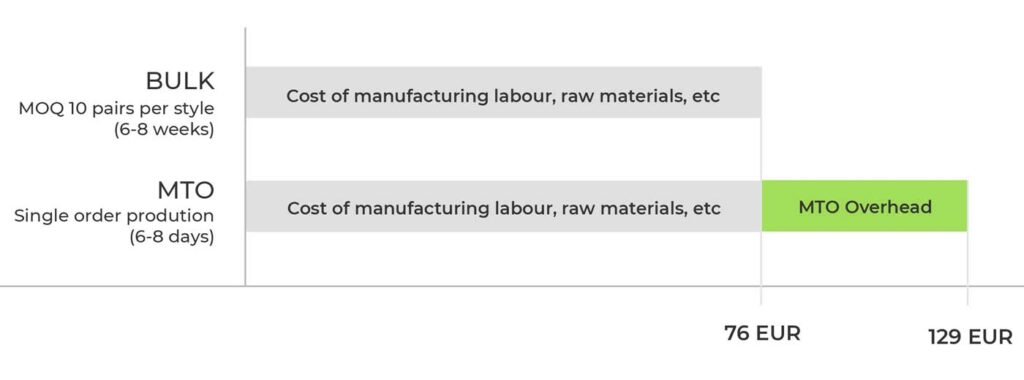
The actual BULK pricing depends on the specific materials used on each shoe piece, the chosen outsole, etc. This example showcases the variation in pricing while highlighting that the quality and materials used in both cases remain identical.
MTO and BULK Orders Defined
Before diving into the cost analysis, let’s clarify what MTO and BULK orders entail. In the MTO model, brands have the opportunity to customize their footwear using a 3D designing tool. Each order is produced individually, tailored to the customer’s specifications, and shipped directly to their customer on their behalf within a remarkably short timeframe of 7-8 days (Fastlane MTO), or 25 days (Standard MTO). On the other hand, BULK orders involve larger quantities (10+ pairs) of a single style, which are manufactured and delivered as a single batch (6-8 weeks of production).
Understanding Cost Differences
It’s crucial to note that the shoe’s intrinsic quality, materials used, and overall craftsmanship are consistent between MTO and BULK orders. Therefore, the disparity in pricing stems from the additional overhead costs associated with MTO production. Let’s explore the factors contributing to this difference:
Additional Staff/Resources for MTO Manufacturing Processes: To efficiently manage the customization and production workflow, MTO orders require dedicated personnel to oversee the entire process, from design approval to final packaging. This extra labor contributes to the overhead costs incurred in MTO production.
Investment in Materials/Components Stock: In contrast to BULK orders, MTO production requires a substantial investment in maintaining a comprehensive stock of materials and components. This ensures prompt availability of the desired options for customization, offering customers a wide range of choices while incurring higher storage costs.
Private Labeled Packaging for Single-Pair Production: MTO orders necessitate individual packaging, often with private labels displaying the brand name and logo of the customer. This personalized packaging enhances the customer experience but adds an additional expense not required in BULK orders.
Dropshipping/Dedicated Logistics for MTO: To streamline the MTO process, specialized logistics are necessary to manage the seamless flow of individual orders. Dropshipping, where the manufacturer directly ships products to end customers on behalf of the brand, adds to the logistical complexity and requires additional resources and infrastructure.
Fast Lane Production Line Offer (7-8 days): The MTO model promises a quick turnaround time of 7-8 days, which necessitates a dedicated fast lane production line. This dedicated production facility ensures that MTO orders are expedited, contributing to the overhead costs associated with meeting shorter deadlines.
MTO Customer Service Department Staff: The personalized nature of MTO orders demands a dedicated customer service department to address any customization queries, assist with design choices, and ensure a smooth customer experience throughout the order process. This department incurs additional staffing costs, further adding to the overhead in MTO pricing.
Conclusion
Understanding the cost differences between MTO and BULK orders is essential for brands. While MTO orders offer unparalleled customization options, quick turnaround times, and individualized packaging, they come with additional overhead costs due to the specialized resources, materials stock, dedicated staff, and streamlined logistics required to fulfill individual orders.
Cost differences between MTO and BULK orders are a reflection of the operational complexities involved in MTO production, rather than a reflection of the quality or craftsmanship of the footwear. Regardless of whether it is an MTO or bulk order, raw materials used, production time and artisans remain the same, ensuring the same focus on quality is maintained throughout both production processes.
Ultimately, our commitment to quality remains unwavering, regardless of the ordering method chosen.